Baroque Solo Concerto
Definition
A multi-movement work written for orchestra and one solo instrument
The word concerto comes from the Latin word concertare, to fight or contend—a sort of contest between solo and orchestra; the same word in Italian and French means to join together.
Early Baroque concertos are mostly written for violin as the solo instrument (such as the solo concertos nos. 6 & 12 of Torelli’s op. 6 of 1698); concertos for other instruments began to emerge later in the eighteenth century, including the cello concertos of Giuseppe Jacchini (op. 4, 1701) and Leonardo Leo, the oboe concertos of Handel and Albinoni, and the numerous concertos for flute, bassoon, and other instruments by Vivaldi and Telemann.
Antonio Vivaldi was one of the most prolific composers of Baroque concertos, composing approximately 425 concertos for one or more soloists, including about 350 solo concertos (two-thirds for solo violin) and 45 double concertos (over half for two violins).
Most Baroque solo concertos (especially in the later period) follow a three-movement plan: fast–slow–fast
The first and the final movement are often in ritornello form
Listening
Antonio Vivaldi, Concerto for Violin and String Orchestra, Op. 8 No. 1, La Primavera (Spring), from The Four Seasons
A solo concerto scored for violin, string orchestra and basso continuo.
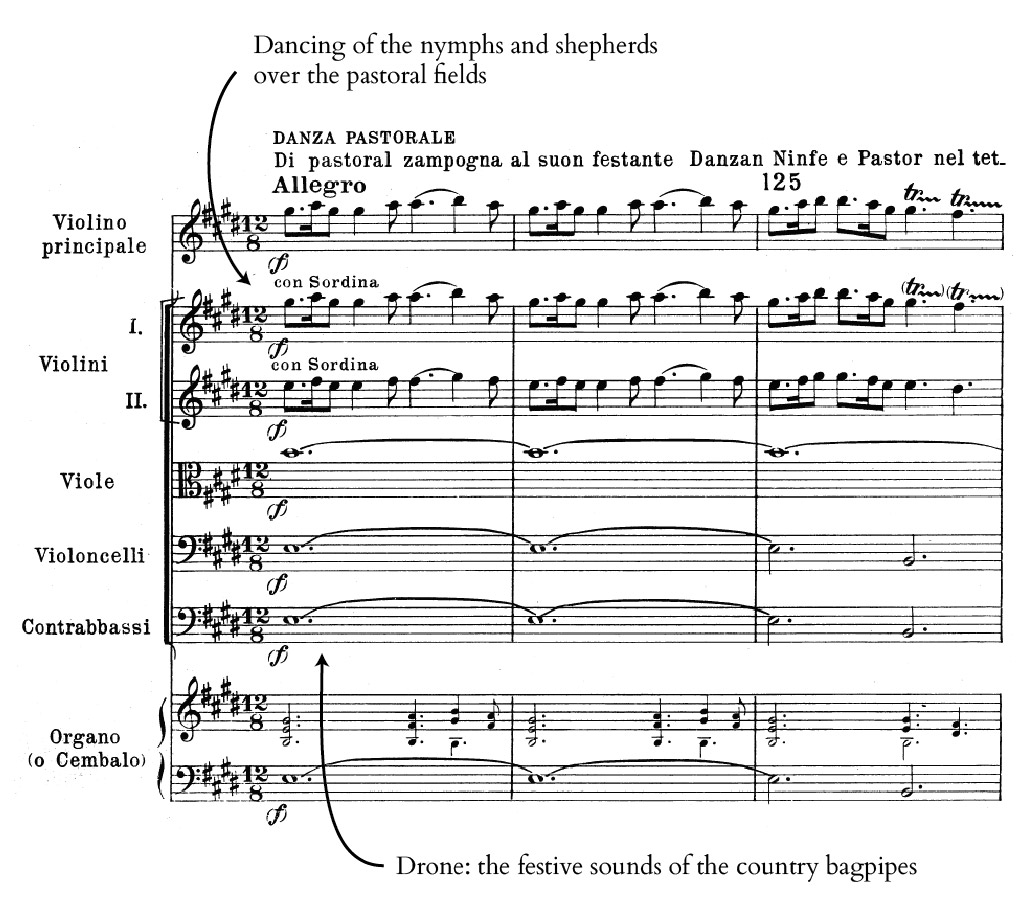
Each movement or section depicts certain scenes or ideas related to a particular season, and Vivaldi placed lines from the accompanying poem in corresponding places of the musical score.
First Movement
Ritornello 1 ("Spring has come, and joyfully")
0:01 Ritornello (opening phrase) appears in E major, played by the entire orchestra in f; ends on the dominant (V)
0:08 Ritornello (opening phrase) repeats in p; ends on the dominant (V)
0:15 Ritornello (closing phrase) complements the first part; ends on the tonic (I)
0:22 Ritornello (closing phrase) repeats in p; ends on the tonic (I)
Solo 1 ("The birds greet it with happy song") – Ritornello 2
0:29 Trills and mordents played by the solo violin and two violins from the orchestra, imitating birdsongs
1:06 Ritornello (closing phrase) played in tutti
Solo 2 ("And the streams, fanned by gentle breezes / Flow along with a sweet murmur.") – Ritornello 3
1:14 Soft-undulating melodic motions played the violins, imitating the murmuring sound of the streams
1:28 Alternating two-note pattern in the cellos
1:35 Ritornello (closing phrase) played in tutti; transposed to the dominant (B major)
Solo 3 ("Covering the sky with a black cloak / Thunder and lightning come to announce the season.") – Ritornello 4
1:41 String playing tremolos in f, followed by a rapid upward scales in the violins; key changes from major to minor, darkening the mood
1:48 Virtuosic passage in the solo violin featuring fast broken chords; ascending sequence
2:07 Ritornello (closing phrase) played in tutti; modulated to C# minor (relative minor key of E major)
Solo 4 ("When these have quieted down, the little birds Return to their enchanting song.") – Ritornello 5
2:15 Solo violin plays in rubato over the sustained bass note from the basso continuo
2:36 Ritornello (opening phrase) varied, bringing the music back to E major
2:47 A scale-like passage played by the solo violin
3:08 Final return of ritornello (closing phrase) in E major, first played in f then in p (like an echo)
Second Movement: Largo e pianissimo sempre
The instrumental parts portray different characters from the poem.
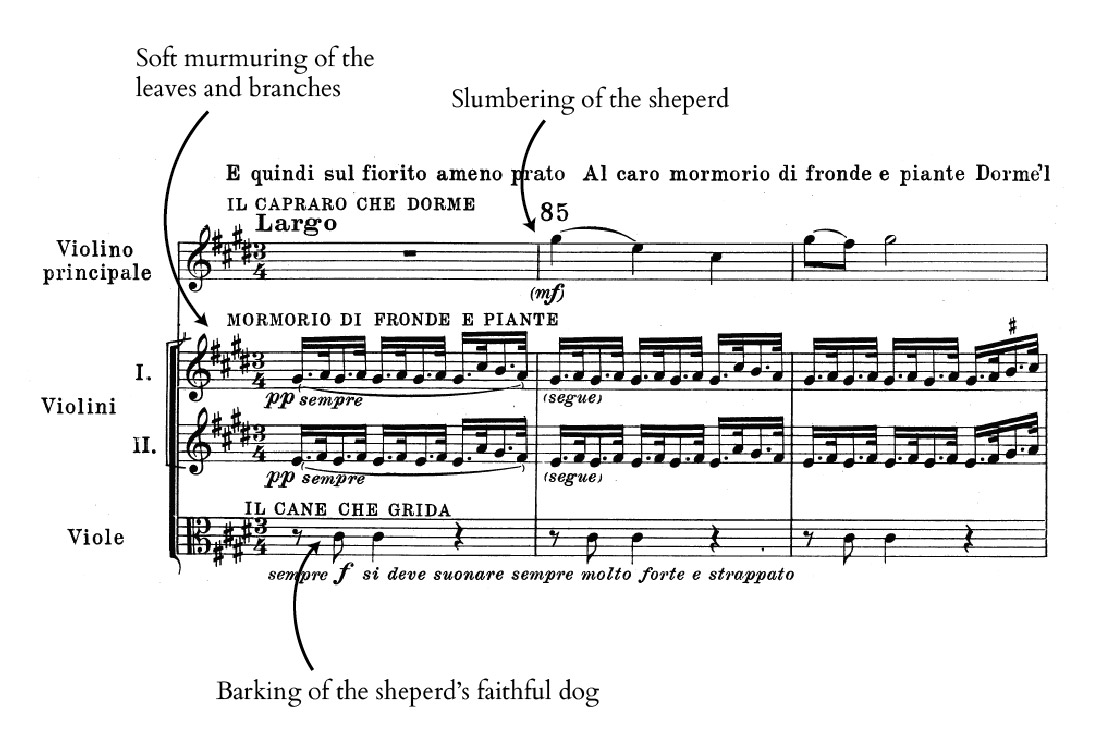
Each part can be divided into three portions: an establishment of the home key (6 bars), followed by a sequential passage (about 6 bars), ending with concluding passage of a cadence (4 bars).
In the second part of the binary form, the soloist embellishs the melody with ornamnets and scale-like figurations, adding variety to the near-identical restatement of the lyrical theme.
3:40 First part (A): establishes the home key (C# minor) by circling around the tonic and dominant chord (I–V–V–I)
4:06 A complete circle-of-fifth sequence (C#–F#–B–E–A–D#–G#–C#)
4:37 A cadential phrase in the dominant minor key
4:52 Second part (A'): soloist added embellishments to the melody
5:09 An ascending sequence (C#–F#–D#–G#) that quickly reverts back to the tonic
5:30 A cadential phrase in the home key of C# minor; repeated
Third Movement: Danza pastorale
The third movement is songlike and soulful, a very brief adagio in triple meter. It opens with a descending leap in the first violin that is immediately imitated a step higher by the second violin.