Baroque Opera
Definition
Baroque opera
A theater play that combines singing, instrument playing, poetry, acting, costume, and stage design
Operas originally started in Italy, hoping to revive the spirit of Greek dramas.
Early Baroque opera composers advocated a new style of singing that better follow the rhythms and pitch fluctuations of speech (from polyphony to homophony); this style of singing is referred to as monody, with one solo voice accompanied by one or more instruments
The first public opera house opened in Venice in 1637.
Elements of an opera
Act: a section of an opera that are separated by an intermission (usually two to five acts)
Scene: a coherent section within an act; usually consists of a recitative followed by an aria
Overture: an orchestral composition at the start of an opera (before the curtain rises), anticipating and preparing the overall mood of the opera; the materials for the overture are often drawn from material heard later in the opera
Recitative: a half-singing, half-reciting vocal line that imitates the rhythms and pitch fluctuations of speech; used to present the story and drive the plot forward
1. Recitativo semplice or Recitativo secco (“simple recitative” or “dry recitative”) - a recitative that is accompanied only by basso continuo; set dialogue and monologue in speech-like manner
2. Recitativo accompagnato (“accompanied recitative”) - a recitative that is punctuated by orchestral outbursts, used to dramatize tense and emotive situations
Aria: a song for solo voice with orchestral accompaniment, used as a lyrical expression of the character’s emotions
Ensemble: two or more characters singing together: duet, trio, quartet, quintet, sextet
Chorus: a group of singers playing the roles of courtiers, sailors, peasants, prisoners, ballroom guests
Libretto: the text of an opera, written for the spoken dialogues, arias, and recitatives (the one who wrote libretto is called the librettist)
Voice types
Soprano (女高音) – Mezzo Soprano (女中音) – Alto (女低音) – Contralto (女低音)
Countertenor (仿女聲的男高音/假聲男高音) – Tenor (男高音) – Baritone (男中音) – Bass (男低音)
Castrato: a male singer who had been castrated before puberty, who possesses the lung power of a man with the vocal range of a woman; nowadays their roles are sung by countertenor
Listening
Claudio Monteverdi, L’Orfeo (1607)
This opera was commissioned by Francesco Gonzaga, heir to the throne of Mantua.
It consists of five acts, each centering around an aria by Orfeo (Orpheus) and ending with a vocal ensemble that comments on the situation.
The setting calls for a large orchestra for performance: recorders, cornetts, trumpets, trombones, strings, double harp, a regal (a buzzy-sounding reed organ) for the scenes in the underworld.
The text is sung through recitatives, a declamatory style of singing that imitates the rhythm and pitch inflection of speech.
Interspersed between the recitatives are choruses and instrumental episodes.
Characters
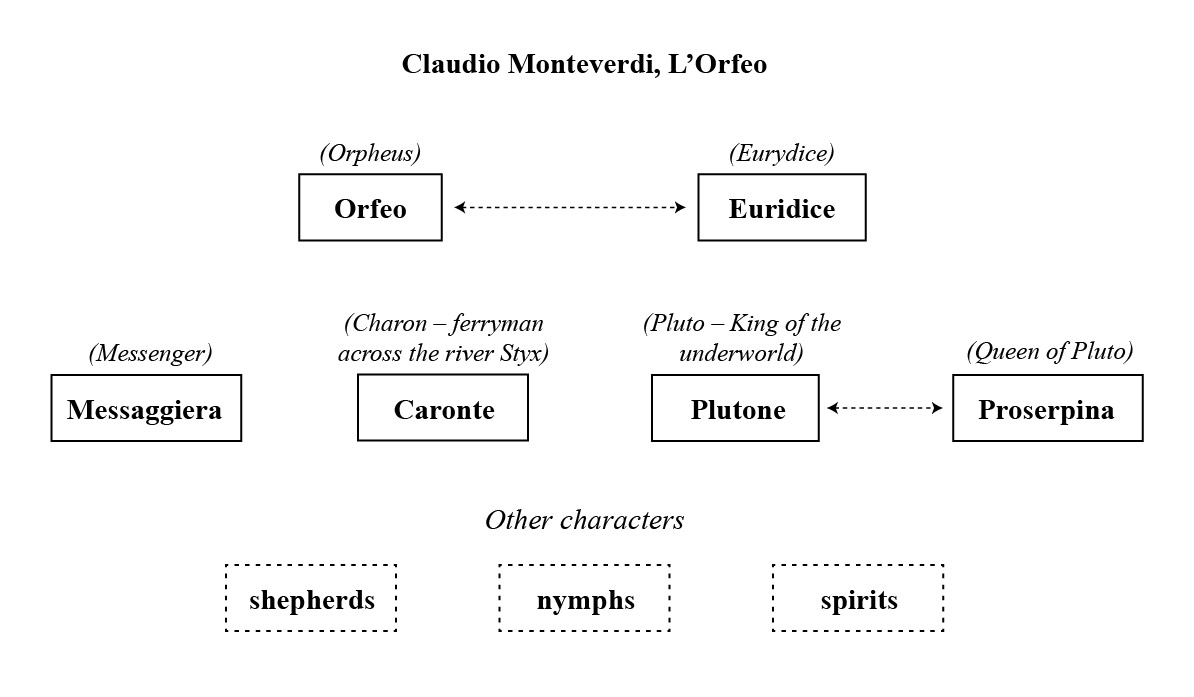
Prologue
La Musica greets the spectators, announces the subject matter of the drama and tells of the wonderful effect that the art of music has on the human spirit.
Orfeo, “Tu se’ morta” (You are dead)
Take note of the word painting on these words:
• stelle (stars) and sole (sun) → high notes
• abissi (abysses) and morte (death) → low notes
Listening
Henry Purcell, Dido and Aeneas (1695)
The opera was first performed by students at a school for young ladies in Chelsea.
The opera consists of three acts, each with a different setting.
Instrumentation: violins, viola, cello, and basso continuo
Characters
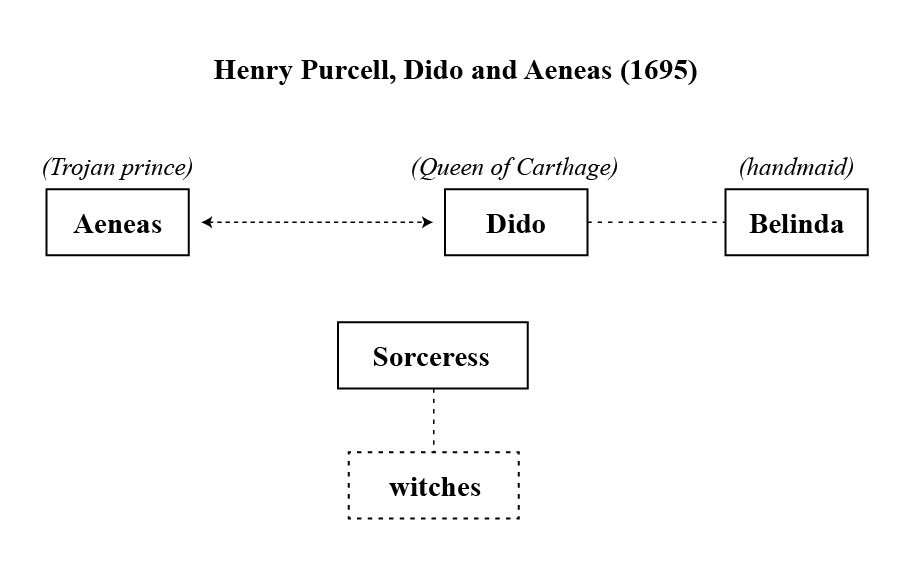
“When I am laid” (Dido’s lament)
Lament: a song or poem that expresses sadness about someone’s death
Ground bass (basso ostinato): a recurring chromatically descending ground bass (ostinato bass) appears 11 times throughout the lament
• chromatic descending bass line → lament (grieve, sadness, despair)
• dissonant chord tones / nonharmonic tones → pain, agony, poignancy, distress
Climax: the emotional and registral high point of a musical section
• repeated notes on the words “Remember me”
• sforzando on the downbeat
0:00 A chromatically descending bass line, ending with a perfect cadence
Listening
George Frideric Handel, Giulio Cesare (1724)
The opera was composed for performance in the Royal Academy of Music, London.
The opera consists of three acts; each act is divided into several scenes, each of which consists of an opening recitative (unfold the story) followed by an aria (express the character’s emotion).
Instrumentation: scored for flute, two recorders, two oboes, two bassoons, four horns, viola da gamba, harp, theorbo, strings and basso continuo
Characters
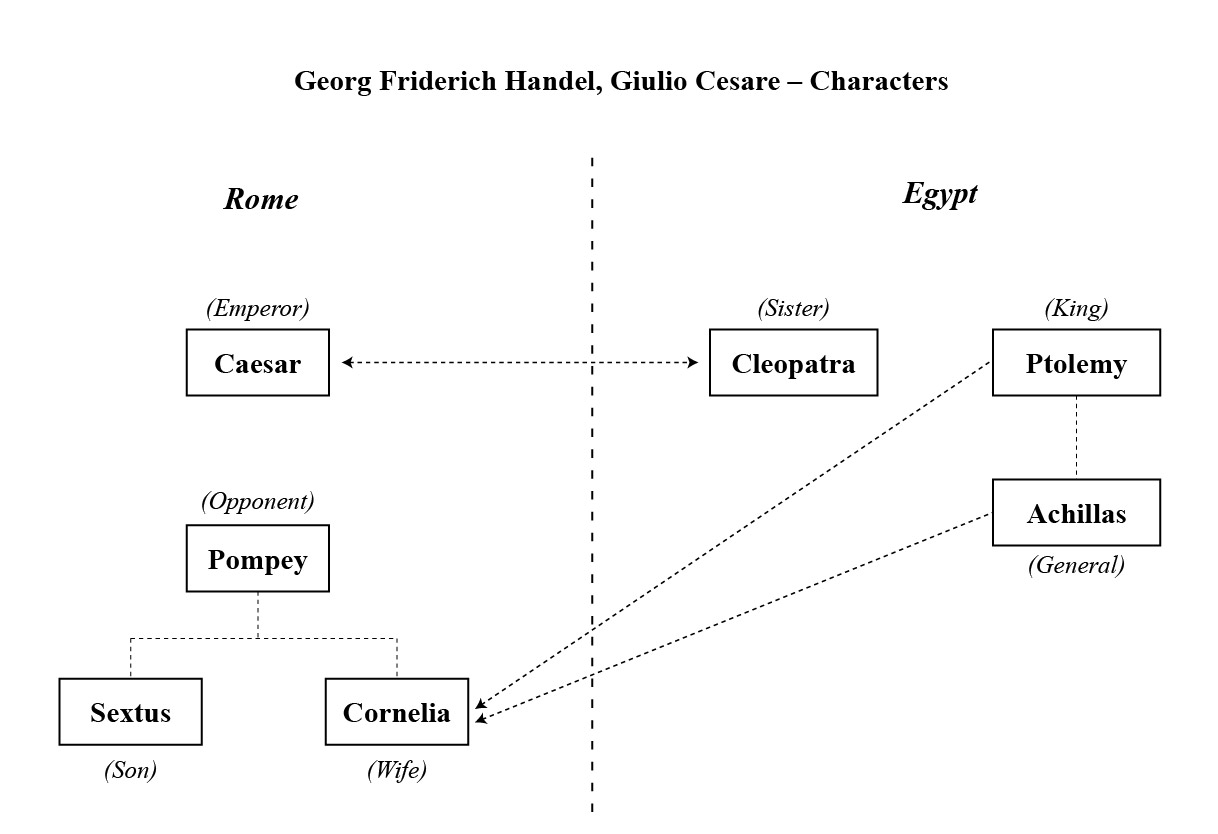
Recitative and Aria