Hard Rock
Background
Rock'n'roll
Rock’n’roll emerged in 1950s, a period of peace and prosperity in America. It quickly gained popularity in 1955-6. It brings together many different styles of popular music, such as rhythm and blues (R&B), boogie-woogie, country music and Tin Pan Alley pop songs.
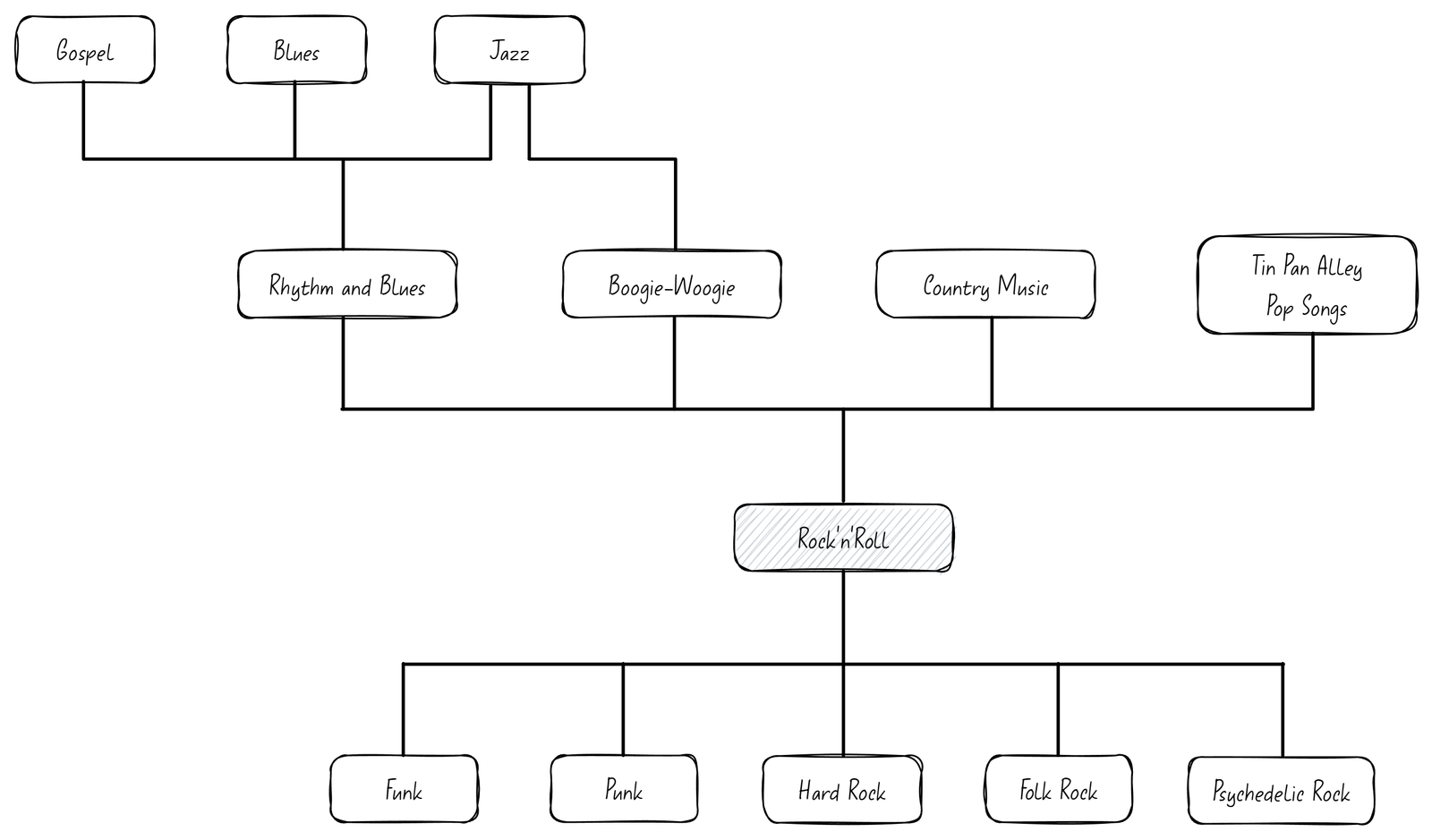
- A. Rhythm and blues (R&B):
originally a label for all types of black music (also referred to as “race
music”); it fuses together blues songs (characterized by the use of
blues scale, 12-bar blues form, and improvisatory singing style), jazz
(particularly swing band and boogie-woogie) and gospel music (a kind of
Christian music centered on expressions of faith and hope popular among African
American communities)
- B. Boogie-woogie: a kind of dance music played on the piano; it features wild and syncopated melody (which is improvised using the blues scales) in the right hand, playing over a steady recurring dotted rhythmic accompaniment in the left hand.
- C. Country music: originally songs transmitted by American immigrants from Britian; it is characterized by simple melodies and narrative lyrics; instruments include banjo, fiddle, mandolin, and string bass.
- D. Tin Pan Alley pop songs: commercial songs composed and performed by white American musicians; they feature memorable melodies, simple rhythms, Western classical harmonies (sometimes with unexpected modulations) and verse-chorus or AABA 16-bar song form. To guarantee commercial success, songs were meticulously crafted and performed by professional songwriters and musicians.
Rock’n’roll became well-known with Bill Haley’s song “Rock Round the Clock”, which was incorporated into the movie Rebel without a Cause.
Elvis Presley is referred to as the “King of Rock’n’roll”. His famous songs include “Heartbreak Hotel”, “Blue Suede Shoes” and “Hound Dog”
Rock
Rock is the broad label for the huge range of styles that have evolved out of rock’n’roll. It gained popularity through radio broadcasts. Popular rock groups include The Beatles, Cream, the Doors, Led Zeppelin, Creedence Clearwater Revival, and the Who.
Hard Rock
Hard rock is also referred to as heavy rock, stadium rock, or cock rock. It features loud volume and assertive masculinity.
Hard rock was characterized by hard, driving rhythms, strong bass drum and use of backbeat (on snare), and short melodies, limited in pitch range. The formal structure of hard rock songs is usually verse-chorus form.
Heavy rock seemed to have two main lyrical themes. First there was the blues-based lyric with its obvious sexuality. The second lyrical theme was fantasy, a development from psychedelic rock, which involved mystical themes or mythical characters.
Led Zeppelin, Black Sabbath and Deep Purple were the first heavy rock bands but they were followed by a multitude of others and the style has continued with little development, except perhaps for an increase in tempo, to the present day.
Other kinds of rock
• Surf rock: emerged in the West coast; themes about beaches, surfing, sunshine, motor cycles, and girls; simple harmonies and light instrumentation Examples: The Beach Boys
• British rock: rock groups from Britian, after the success of The Beatles Examples: The Yarkbirds, Manfred Mann, The Kinks, Small Faces, Pink Floyd
• Folk rock: originated from Bob Dylan, who combines folk music with rock Examples: The Byrds
• Garage rock: underground bands characterized by authentic passions and a lack of polished techniques
• Psychedelic rock: rock songs that are related to, or performed under the influence of, psychedelic drugs
• Blues rock: a fusion of blues and rock music; improvisatory singing Examples: Bluebreakers, Cream
• Progressive rock: a type of rock with influences from classical music; aims to transform rock into a more serious style
• Heavy metal: a noisier style of rock; use of distortion and overdrive effects Examples: Van Halen, Metallica
• Punk: a more distilled style of rock music Examples: Sex Pistols, The Clash
• Funk: a freer style of rock music with strong rhythmic beats Examples: James Brown, George Clinton
• Alternative rock: rock groups outside the mainstream; more experimental Examples: Nirvana
• Electronica: a fusion of rock and electronic music Examples: The Chemical Brothers, Moby
Characteristics of Hard Rock
Instrumentation
- Use of electric guitar & bass guitar
- intro often introduces a guitar riff (played by both the lead guitar and bass guitar together) that forms the foundation of the entire song
- syncopated guitar chords (power chords) are used to provide a perpetual rhythmic drive
- tresillo or double tresillo rhythmic pattern
- power chords: chords using the root note and the fifth note (chords in perfect fifths)
- multiple guitar parts performing together
- distortion effects
- vocals: powerful vocals in an aggressive style, sometimes ornamented with screaming and wailing sounds
- drums: a clean drum sound with strong backbeats (2nd and 4th beats) on the snare and heavy bass drum pulses on the downbeats (1st and 3rd beats)
- keyboard (occasional)
Lyrics
- themes about rebellion, love, fantasy, freedom, and self-expression
Performance
- emphasis on authenticity and live performance experience
- raspy and rough-edged singing
- vocal fry (creaky voice)
Form
- verse-chorus form, often with a bridge in the middle featuring drums and guitar solo
Harmony
- (guitar and keys) double plagal cadence
- melodic-harmonic divorce in the verse section
Scales
- blues scale: introduce blue notes (b3 and b7) into the melody or harmony
- pentatonic scale: able to accommodate four different modes
Listening
Led Zeppelin, Black Dog (1968)
“Black Dog” is the explosive opening track of Led Zeppelin’s untitled fourth album (Led Zeppelin IV, 1971), blending hard rock, blues rock, and an unusually tricky stop-start rhythm. Its rolling riff was devised by bassist John Paul Jones, while Robert Plant’s a cappella-style vocal phrases answer Jimmy Page’s guitar and John Bonham’s steady drums.
The lyrics use classic blues themes of desire, obsession, and betrayal. Despite its ominous-sounding title, it was named after a black Labrador that wandered around Headley Grange, where the band recorded.
AC/DC, Back in Black (1980)
“Back in Black” is AC/DC’s 1980 hard-rock anthem and title track from Back in Black, the band’s first album with singer Brian Johnson after Bon Scott’s death. Built around one of rock’s most recognizable guitar riffs, it is both a tribute to Scott and a defiant declaration that the band had returned.
The song’s sparse, punchy riff, Johnson’s rasping vocals, and Phil Rudd’s relentless drums give it a raw, celebratory force. Its title and all-black album artwork also functioned as mourning for Scott, while the music presents survival and resilience rather than grief.
Mr., 黑色狂迷 (2017)
“黑色狂迷” (“Black Fanatic”) is an energetic Cantonese pop-rock anthem by Hong Kong band Mr., originally released on Like Black (2010) and included on the 2017 compilation We R Mr. – Vol. 1. Written by Dash with music by Alan Po, it uses black as a symbol of individuality, rebellion, and unrestrained passion.
The song urges listeners to embrace their “wild” side and live intensely rather than conform to a dull, conventional world. Its driving rock arrangement and communal “Everyone, let’s scream” chorus made it one of Mr.’s signature concert numbers.
陳奕迅, 破壞王 (2018)
「破壞王」 ("We Zzzid It") is a playful, high-energy Cantonese rock song by Eason Chan and his touring band eason and the duo band, released in 2018 as the second track on the album L.O.V.E. Written by Chan Wing-him and composed by Carl Wong, it celebrates mischief, curiosity, and refusing to be “normal.”
The lyrics portray a “troublemaker” who disrupts dull routines and conservative expectations, using destruction as a metaphor for creative freedom and youthful rebellion. Its brisk rhythm, quirky arrangements, and chant-like chorus give it a mischievous, carnival-like character.